How Shanghai powers the world’s fastest port operations?
By Han Xin, People’s Daily
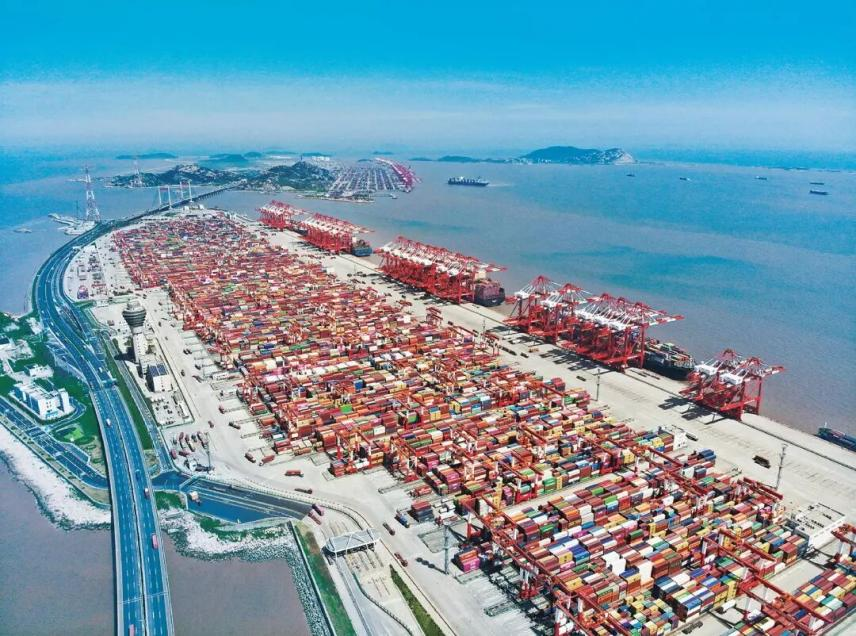
On Xiaoyangshan Island, off Shanghai’s southeastern coast, the port hums with nonstop activity. Giant vessels rest alongside the berths. Quay cranes tower overhead. Hundreds of automated guided vehicles (AGVs) move seamlessly between the yard and the shore, sorting and stacking multicolored containers. The entire operation runs with smooth precision — with barely a human in sight.
This is the phase IV automated terminal of Shanghai Yangshan Deep Water Port, the world’s largest single-unit automated container terminal. Since it opened in December 2017, the terminal has repeatedly set global records for operational efficiency. At its peak, a single crane has handled over 60 container moves per hour, making it one of the most productive terminals in the world.
What gives this port the world’s fastest handling speed? The answer lies in its digital brain.
In a remote-control operations room, the terminal’s digital twin system is on full display. The entire port — from massive ocean-going vessels down to individual containers — is mirrored across a wall of digital screens, updated in real time.
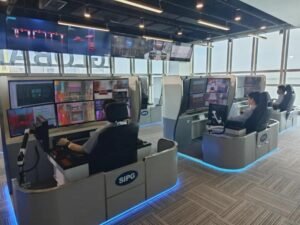
“Powered by our independently developed intelligent terminal production management and control system, we have achieved unified, end-to-end scheduling of 29 quay cranes, 121 rail-mounted gantry cranes, and 155 AGVs,” said Wu Jilin, head of technological innovation at the Shandong Branch of Shanghai International Port Group, which manages and operates the terminal. “This has increased waterfront loading and unloading efficiency and overall yard capacity by about 30 percent compared to traditional operations.”
The terminal’s “mechanical limbs” are equally agile. From the waterfront crew room, twin-lift quay cranes can be seen steadily lifting containers from ships and placing them onto AGVs, which then carry the containers to the yard, where rail-mounted gantry cranes stack them in designated positions.
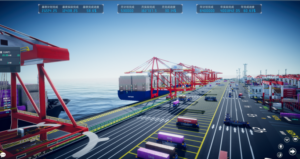
The smoothness of these movements depends on a pair of “nimble hands” located far away. Using the world’s first remote-control technology for large-scale cargo-handling equipment based on an F5G all-optical network, crane operators have moved from the driver’s cabins at the port to control centers more than 30 kilometers away, and even to remote sites in downtown Shanghai, over 100 kilometers from the terminal. With a simple joystick movement, they maintain precise control.
A fully streamlined logistics backbone makes the system even more efficient. Inside a smart heavy-duty truck transport center, a two-level operation space is in view. On the upper level,