LAHORE: Three historic monuments at the Lahore Fort — the Sikh-era Hammam, the Athdara Pavilion, and the Loh Temple — were officially inaugurated on Sunday after the completion of extensive conservation work funded by the U.S. Ambassadors Fund for Cultural Preservation (AFCP). The restoration was carried out by the Aga Khan Cultural Service – Pakistan (AKCS-P) in partnership with the Walled City of Lahore Authority (WCLA).
The unveiling forms part of a broader initiative titled Preservation and Promotion of Cross-Cultural Edifices of Lahore Fort, which seeks to safeguard and celebrate the Fort’s rich and diverse heritage. Earlier under the same programme, two other historic sites — the Sikh-era Temple and the Imperial Zenana Mosque — were restored. Collectively, these efforts now cover seven key monuments within the Fort, reflecting its layered Mughal, Sikh, Hindu, and British history.
The Loh Temple complex, located near the Alamgiri Gate, comprises interconnected chambers featuring ritual elements associated with Hindu practices, alongside architectural features from the Sikh era. The Athdara Pavilion, situated in the northwest precinct of the Shah Jahan Forecourt Quadrangle, was constructed during the Sikh period and historically served as a public court. The Sikh Hammam, located at the northeast corner of the Sheesh Mahal Quadrangle, was originally built during the reign of Emperor Shah Jahan and later adapted into a hammam during the Sikh era.
The inauguration ceremony, held at the Shah Burj Forecourt, was presided over by Punjab’s Provincial Minister for Minorities Affairs, Sardar Ramesh Singh Arora, as the chief guest, while Sandeep Paul, Public Affairs Officer at the U.S. Consulate in Lahore, attended as the guest of honour. The event brought together participants from academia, government, and the arts community.
Opening remarks were delivered by Tausif Khawaja, Chief Executive Officer of AKCS-P, followed by addresses from Sandeep Paul and Najamus Saqib, Director General of WCLA, who highlighted the cultural significance of the Lahore Fort and the importance of preserving its heritage.
Speaking on the occasion, Sandeep Paul underscored the strategic partnership between the United States and Pakistan, identifying heritage conservation as an important area of collaboration.
“Preserving the past is not about nostalgia; it is about investing wisely in the future,” he said. “These restored monuments will attract visitors, create economic opportunities, and stand as lasting symbols of what we can accomplish together.”
Tausif Khawaja stressed the cultural and historical importance of the restored sites, describing them as embodiments of cross-cultural harmony.
“The cross-cultural edifices of the Lahore Fort reflect a shared heritage,” he said. “The Loh Temple being inaugurated today is not only historically significant but also a sacred site visited by people from across the border. Similarly, the Athdara Pavilion, though seemingly simple, holds deep significance for the Sikh community, as Maharaja Ranjit Singh held court here. Behind it stands the Sikh Hammam, which features exquisite and delicate oil paintings from the period.”
The conservation process was detailed in a presentation by Wajahat Ali, Director of Conservation and Design at AKCS-P, who outlined the initial condition of the monuments, the challenges faced, and the techniques employed during restoration.
Najamus Saqib described the Lahore Fort as a reflection of multiple historical eras, spanning from the Mughal to the British period. He said ongoing efforts aim to preserve these historical layers so future generations can understand the distinct importance of each era.
Reflecting on the significance of the project, Sardar Ramesh Singh Arora said the restored sites symbolise Punjab’s long tradition of inclusivity.
“This project is significant not only for conserving historic structures but also for what it represents — the recognition and protection of Punjab’s pluralistic heritage,” he said. “It serves as a powerful reminder that Lahore has long been a shared civilisation of people from different faiths and cultures.”
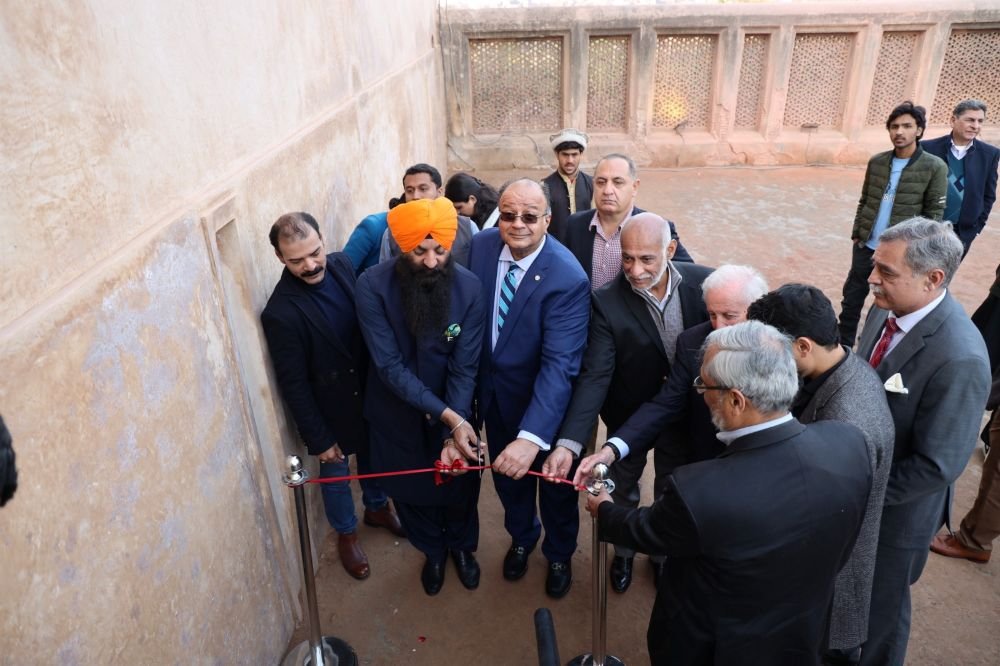
The programme included ribbon-cutting ceremonies at the Loh Temple, Sikh Hammam, and Athdara Pavilion, followed by site visits. The event concluded with the presentation of souvenirs to the dignitaries by Luis Monréal, General Manager of the Aga Khan Trust for Culture (AKTC).