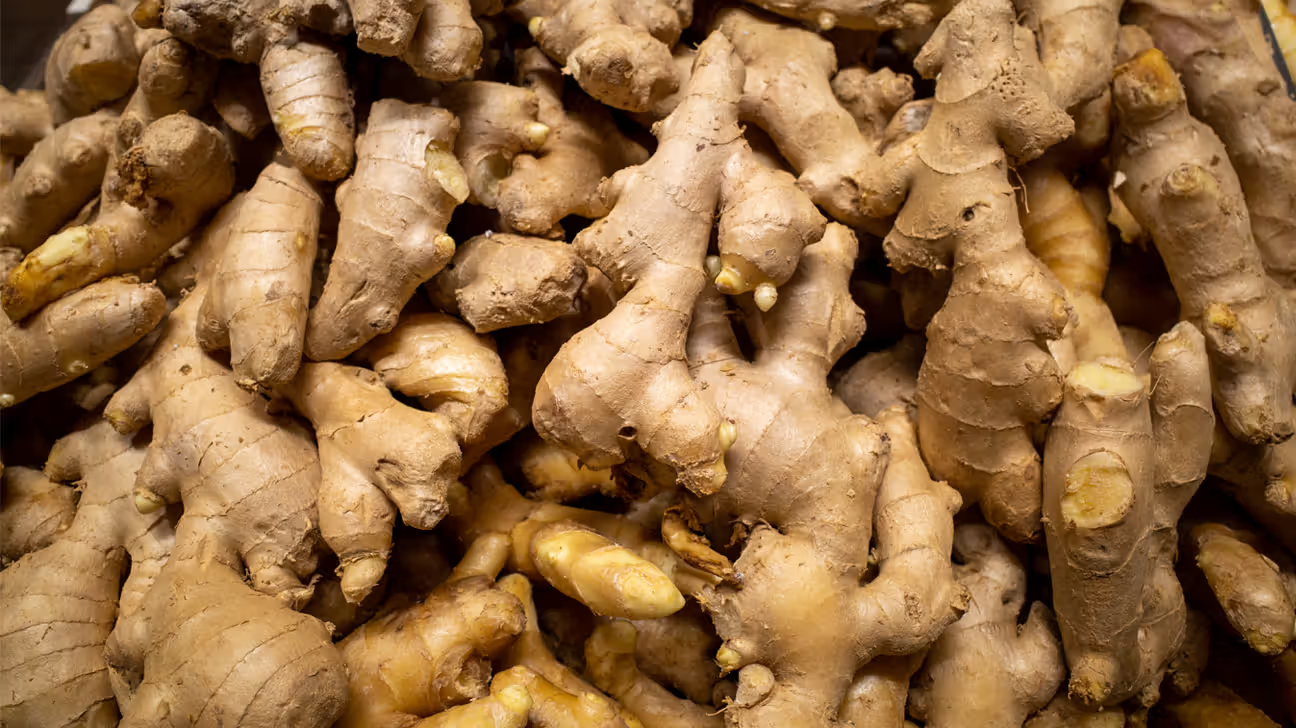
ISLAMABAD, Jan 11 (APP): Pakistan has developed five advanced ginger breeding lines as part of sustained research efforts aimed at establishing domestic ginger cultivation after decades of unsuccessful trials and complete reliance on imports.
Dr Muhammad Iqbal, Principal Scientist and Director at the Vegetable Research Institute of the Ayub Agricultural Research Institute (AARI), Faisalabad, told Wealth Pakistan that the newly developed breeding lines are currently under multi-locational trials and have shown encouraging results at several sites. He said the progress marks a major milestone in Pakistan’s long journey toward local ginger production.
“Until a few years ago, ginger was not grown in Pakistan. It was 100 percent imported,” Dr Iqbal said, adding that the current achievements are the result of long-term persistence and sustained research. “Now we can confidently say that we can grow ginger.”
According to him, years of experimentation have helped scientists identify the Potohar region as particularly suitable for ginger cultivation. Successful trials were conducted at Dawri Farms in Rawat and Nishtar Farms in Chak Shahzad, where recent harvests produced strong yields. “Our crop this year is almost equivalent to that of Thailand,” he said, adding that yields recorded at Dawri Farms were “much higher than India.”
Although Pakistan currently ranks low among global ginger-producing countries, Dr Iqbal said yield performance at select local sites demonstrates significant untapped potential. He noted that with the development of more suitable sites, Pakistan could achieve self-sufficiency and eventually move toward exports.
The path to this stage has been long and challenging. “It was not that our institute did not try. We kept trying, but there was no success,” he recalled.
A major breakthrough came after renewed research initiatives launched from 2017 onward. These included extensive trials under shade structures in Narowal, Gujranwala, and Sialkot, which helped scientists identify gaps in production technology and refine cultivation practices. “These locations and everything that is happening now are based on that research,” Dr Iqbal said.
Alongside the five advanced breeding lines, AARI has also developed a local ginger variety, AARI Ginger-2023, suitable for general cultivation. In addition, the institute is maintaining multiple ginger genotypes sourced from China and Thailand. Dr Iqbal said the advanced breeding lines have also produced successful results in Azad Jammu and Kashmir and the Bara area.
To address the shortage of quality planting material, AARI has established a tissue culture laboratory to multiply disease-free ginger plants. Dr Iqbal explained that ginger rhizomes available in markets are treated for consumption and often fail to sprout. “We grow them in the lab and provide tissue culture plants for rapid multiplication,” he said, adding that large numbers of plants have already been distributed.
At present, ginger cultivation in Pakistan is limited to areas including Rawat, Chak Shahzad, Chichawatni, and Jaranwala. Last year marked the first time that locally grown ginger entered the domestic market.
Scientists are now training master trainers and disseminating ginger production technology through print and electronic media, while ginger festivals have also been organised to raise farmer awareness. “In the past, we used to think this was not possible,” Dr Iqbal said. “Now we have a success story.”
With proof of concept established, the government has launched an expansion drive in the Potohar region, offering support for tunnels, shade nets, seed availability, and drip irrigation under a cost-sharing arrangement between farmers and the state. Applications have been invited from Rawalpindi, Jhelum, Chakwal, Talagang, Murree, and Khushab.
Under the programme, cultivation will be expanded in phases over the next three years, with selected farmers committing to grow ginger for at least a decade to ensure sustainability.
Beyond fresh consumption, researchers are also working on value addition, including pickles, dried ginger, and powdered products. Dr Iqbal said Pakistan’s ginger has shown promising quality traits, including higher gingerol content, which could translate into better taste and longer shelf life.
While ginger requires significant upfront investment and offers limited returns in the first year, he said profitability improves from the second year onward.
With durable infrastructure and minimal disease pressure observed so far, he described ginger as a high-value crop with strong long-term potential.
“The government wants to increase self-sufficiency because all this money is going out in imports,” Dr Iqbal said. “If local production starts, it will benefit both the government and the country.”